
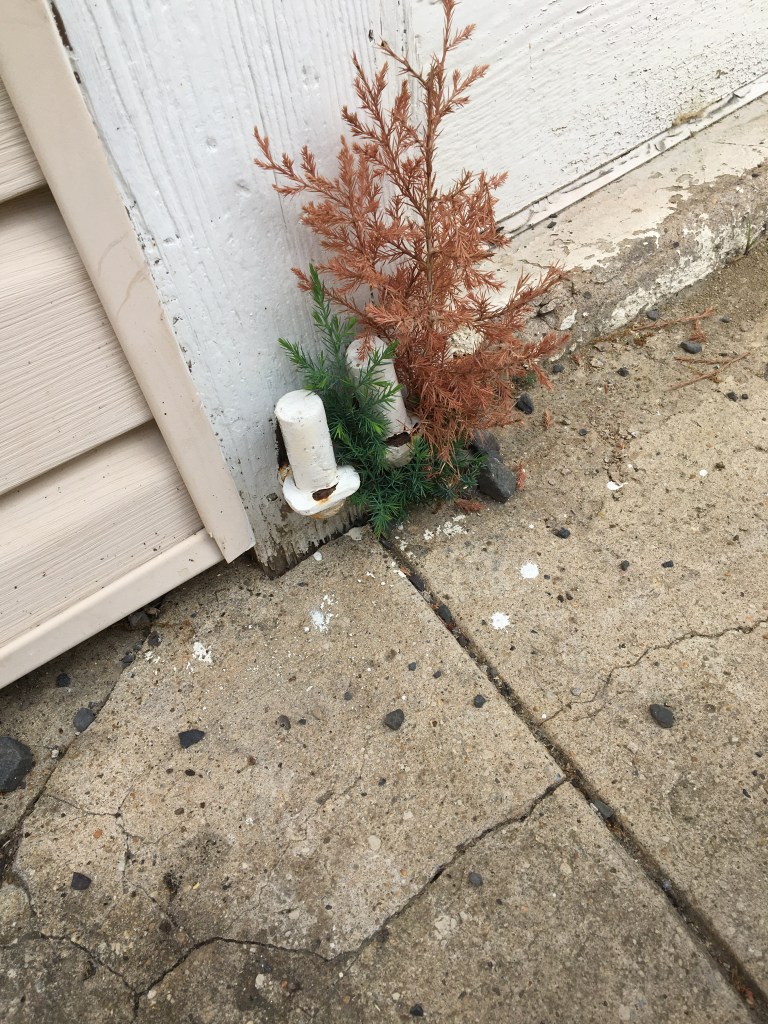
Sorry to burst your bubble, but the simple answer is: you will have weeds. I know, it’s a bummer. Even if you pick, hack and spray every weed to oblivion, your neighbors may not feel the same way and weed seeds can blow onto your lawn and into your beds. Birds can sit in your bushes, trees and awnings to relieve themselves…of weed seeds. Even if you cover your property in concrete, it can still crack…and grow weeds. Please see the following:

So, what can you do, especially if you don’t want to spray chemicals each time you see a weed? Here are some simple methods to reduce the presence of weeds on your property:
- If you have large spaces within your property, such as within beds, underneath trees or within a lawn, the first method is to use a mower or string trimmer to remove any weeds. Repeatedly cutting down a weed is usually a good way to get rid of woody, perennial or annual weeds growing en masse. A once a month visit is usually good enough to contain and hopefully eradicate weeds on a large scale.
2. Once you have removed weeds in open spaces, identify if the plant is a woody perennial, herbaceous perennial or annual. If it is a woody perennial, try to pull/dig it out, especially if it is in the first year of growth. Cutting a tree at the base of the soil just causes it to grow another stem and its eventual “trunk” to grow thicker while deepening its roots. If it is older (at least 1′ in diameter), cut the weed a couple inches from the soil, drill a hole down the middle (at least 2″) and pour salt and vinegar into the hole. This will help to kill the plant and works best if rain is not in the forecast for at least 24 hours. You can also apply a light coating of vegetable oil or wax over top of the hole to reduce water exposure that will dilute the salt and vinegar.
3. If it is a perennial, pull it up by the roots. Chopping away at aboveground herbage will not prevent it from regenerating from the roots (Ex. pokeweed). If it is an annual, you can chop it down at soil level or pull it up. This works best on a hot sunny day.
Whether the plant is woody, perennial or annual, the cardinal rule is, ALWAYS REMOVE WEEDS BEFORE THEY FLOWER AND PRODUCE SEED! Unless you like weeding…
4. There are some weeds that are pretty persistent (Note: invasive weeds). Notorious culprits who can regenerate from pieces of root left in the ground after being mowed or pulled include Canada thistle, porcelain berry and japanese knotweed. Most people will tell you to spray an herbicide. There are many reasons not to use conventional herbicides, particularly in residential settings. The secret to getting rid of these weeds is to wait until they are flowering. The plant is in reproduction mode, thus has expended an abundance of energy to hopefully contribute to the next generation (or so it hopes!). When a plant of disinterest begins to flower, cut the plant down to the base, approximately 1-2″ above the ground. Then, apply a natural herbicide such as vinegar or salt solutions (Again, a coating of oil helps to make these solutions more environmentally stable).
5. Once you have weeded your property, apply mulch in areas where grass or moss are not growing, specifically in beds where plants are not planted. Essentially, where soil is exposed and light and water can penetrate, a weed will grow. Although mulch will not prevent all weeds, they greatly reduce weeds under shrubs and trees with less dense canopies and make removing future weeds easier. A great mulch for beds is to apply a layer of fresh wood chips, ideally pine, in a 1-1.5″ layer and then coat with a more decorate bark or organic mulch of your preference. Although some might critique that wood chips will “deplete” nutrients within the soil, this is only applicable to the surface layer and will not affect deep-rooting perennials, shrubs and trees.
Another great “mulch” to consider is using hardscaping in areas where you have space in beds and/or may access other parts of beds or in often neglected areas of your property, such as on the sides around a/c units. Hardscaping, particularly large pavers or stones, presents an impermeable surface for weeds to grow through, especially if it is used on top of another mulch, such as wood chips. If you choose to use weed barrier, make sure it is applied in a manner that will provide long-lasting weed prevention (see here for more details).
6. Ultimately, mimicking nature is the best way to minimize weeds. This means that nutrients should be regenerated as much as possible and plants put in places where they can thrive and compete with even the most stubborn weeds. Try and plant beds as densely as possible to minimize space for weeds to come in contact with soil surfaces. Shredding leaves and using them as a mulch under trees or within beds regenerates nutrients while also providing a smothering layer on top of the soil until leaves break down by the next fall. Shredding leaves, whether via a lawn mower or leaf shredder, is an important step because it prevents leaves from blowing away while making them more compact. Likewise, mulching grass clippings regenerates nutrients within a lawn and keeps grass healthy. In nutrient deficient soils or where mulching is not desirable, using organic fertilizers can help to ensure that grass will grow densely and prevent weed generation. Finally, applying compost to beds helps to ensure that perennials grow vigorously, with greater canopies and leaf growth that shades soil below and more vigorous root structure that prevents weeds from competing for nutrients.
7. If you really want a sustainable approach, embracing many plants that are considered weeds can reduce your efforts to manage them. Many weeds, such as wood sorrel and purslane have ornamental varieties selected to improve appearance. If you want to save some $, you can opt for the wild-type forms and accept their natural appearance. Many weeds, such as wood sorrel, purslane as well as chickweed, lamb’s quarters, and dandelion, are edible and provide a nice alternative to the salad bar. Other weeds, such as pokeweed or clover, are native and provide food sources for winged creatures or, in the case of clover, provide valuable environmental functions including nitrogen fixation.
These are some of the many ways that you can manage weeds on your property. If you are looking for more information on specific problems affecting your site, please don’t hesitate to reach out via the contact page. No need to be troubled by weeds!
 ECOworks llc