
Most people seem to think that weed barrier is a “set it and forget it” strategy to eliminate weeds forever. Oh, Mother Nature, how they try to defy your ways! While there is no surefire method to completely eradicate weed growth in most sites on an infinite time scale, avoiding some of these classic mistakes will help you to get the most out of your weed prevention efforts.
- DON’T USE A CHEAP WEED BARRIER MATERIAL!
When remedying homeowner’s weed prevention efforts, I typically see two weed fabric materials used: a very cheap plastic type that has the strength of a disposable table cloth and very thin landscape fabrics, such as from a big box store.
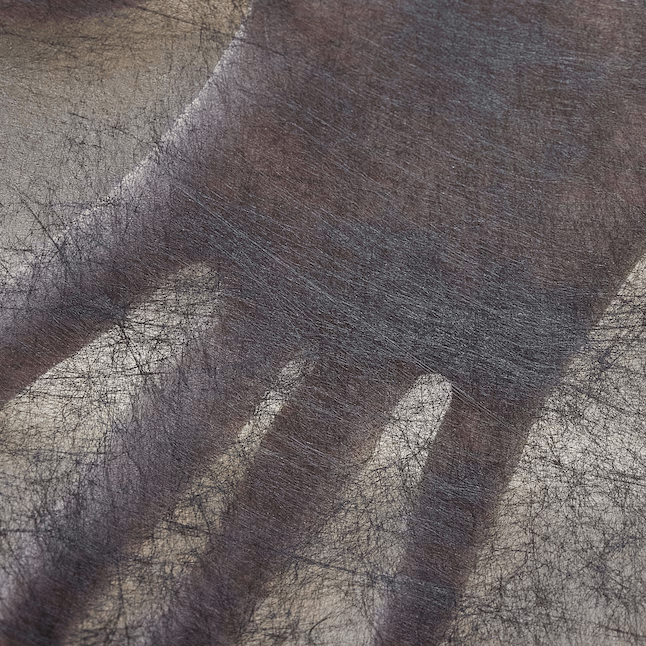
(from lowes)
The rule of thumb is: a quality weed fabric would not allow you to see your thumb (and the rest of your hand) through the fabric! While the trade-off is that thicker fabrics are slightly more expensive and slightly less permeable, the reality is that the thinner the fabric is, the more likely it will tear, thus negating any weed prevention investment. If you are going to put down a weed barrier, using a material that is at least 5 oz will provide a minimum level of strength. Depending on the application, particularly for underneath hardscaping projects or inorganic materials such as crushed stone, 8 oz may be more appropriate. Despite claims to the contrary, using thicker materials are more cost effective as they are more durable, thus reducing the need to constantly replace torn weed fabric. And, if you buy in bulk (such as from Allied), they are usually less expensive than more conventional brands.
2. AVOID PUTTING MULCH ON WEED FABRIC!

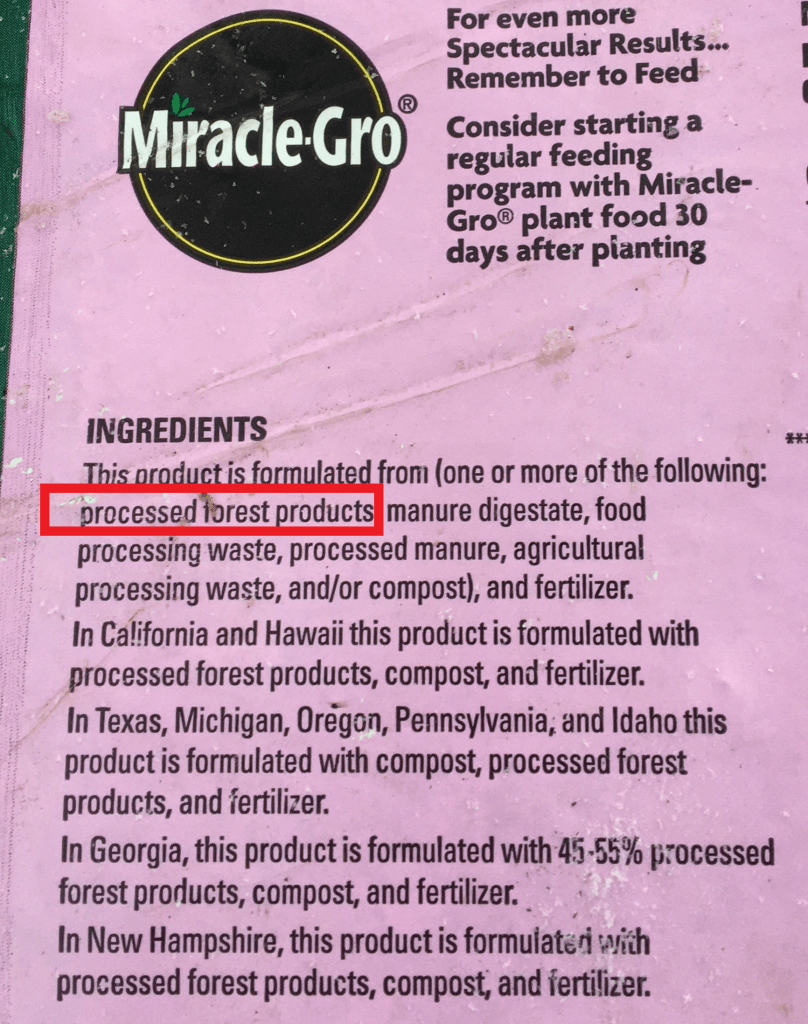
I have never entirely understood why this is done, for the simple reason illuminated by Miracle Grow above: processed forest products (note: bark mulch) are used in potting soil! If you put bark mulch on your weed fabric, you are essentially putting potting soil for weed seeds! You will be weeding anyway, so why put down the weed fabric? While most weeds are not much of a problem to remove from on top of weed fabric, aggressive weeds such as Bishop’s weed (pictured below), bamboo and select tree seedlings (among other plants) can grow through weed fabric, either spreading from rhizomes below or growing on top.
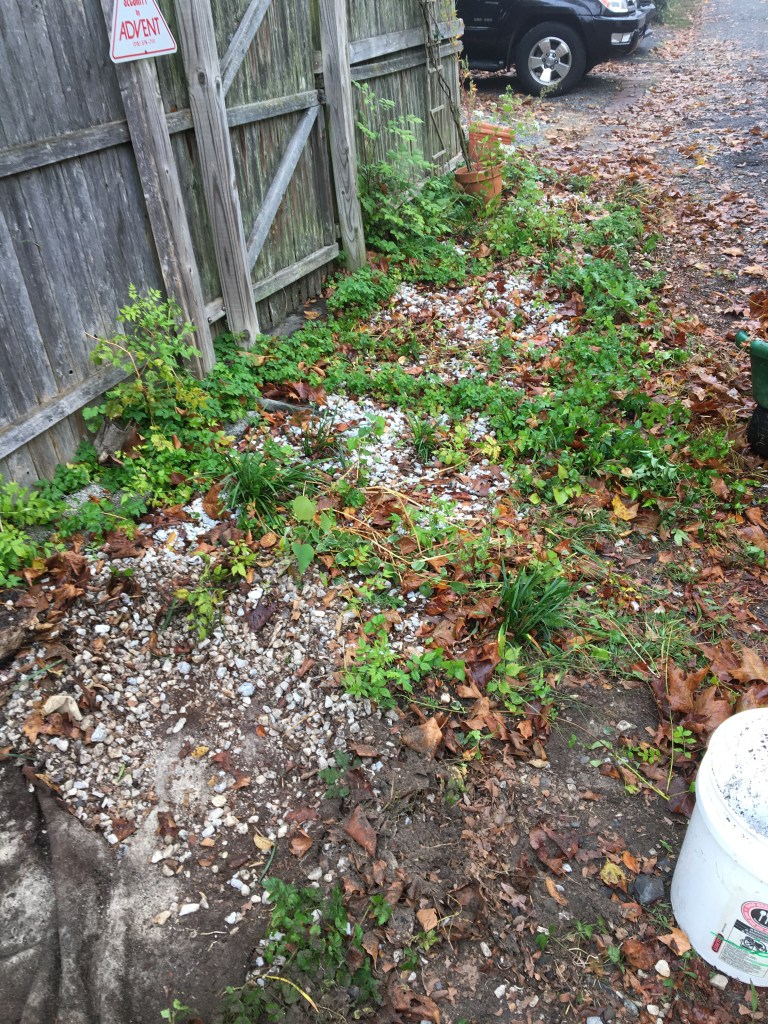
As visible above, even if weed barrier is in place, leaves, soil and other debris that remain in inorganic mulch can provide enough of a germinating medium for weeds to thrive. While thicker weed fabric (> 5 oz) can prevent weed seedlings from penetrating the fabric, there are really two choices when it comes to mulch, weed fabric and weed prevention: either skip the fabric and use only a thick layer of mulch OR only use weed fabric with an inorganic mulch, such as crushed stone, glass or rubber mulch, that won’t grow weed seeds in it (if it’s kept clean…). Remember: the thicker the fabric, the less water that can drain through, which may impact surrounding plants or the rest of your landscape.
3. IMPROPERLY INSTALLING WEED BARRIER ON A SLOPE!
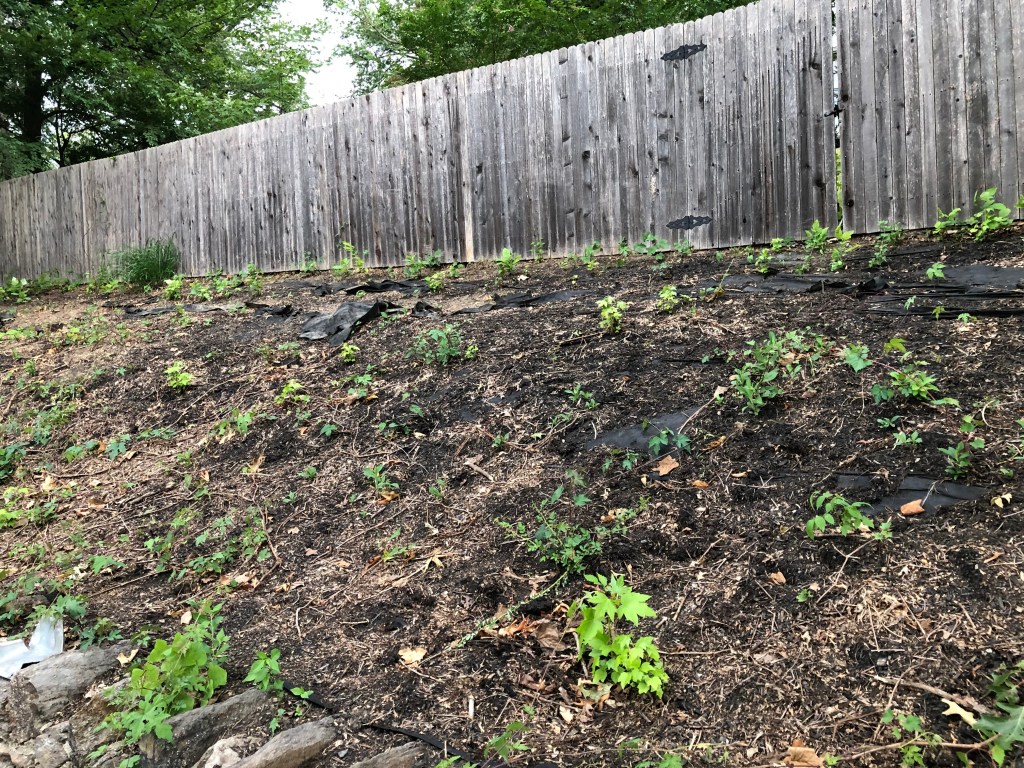
As the above picture indicates, using weed barrier on a slope poses many problems. Various companies will present weed barrier with “fuzzier” sides meant to increase adhesion, but realistically, erosive forces (wind, water, gravity) and any foot traffic will cause any mulch on top of the weed fabric (often bark mulch!) to gradually descend down the slope, exposing the weed fabric. Unless the weed fabric is staked at 1′ intervals, it will also become displaced (as visible at the top of the photo). Thus, efforts to prevent weeds will be seedy and weedy.
The solution? Unless one is going to take great measures to use extra stakes and minimize foot traffic, abandoning weed fabric is often the way to go (particularly, as with this space, if one needs to go through and weed anyway…). One of the best strategies would be to put down a thick layer of mulch or even wood chips while planting some perennial or small, shrubby plants along the top of the wall (bottom of the picture) as a border. Field stones could also be used as a barrier at the bottom, or can be partially buried into the slope to create a berm; shallow berms and swales could also be dug into the hill to prevent mulch subsiding. Wood chips aren’t “sexy”, but they have more mass and abrasive surfaces that cling to the slope while also impeding plant growth. Ultimately, sufficient spreading ground cover, such as ferns, sedges, bugleweed or even vinca, would do better to cover the slope and minimize plant growth rather than putting down weed barrier that only falls down the slope.
4. CUTTING THE WEED BARRIER, THEN CHANGING YOUR MIND!
Quite often, elaborate landscapes are designed, with landscape fabric being used under black mulch to surround new plantings. Then, homeowner’s change their minds: they pull plants out, they put new plants in, they do the hokey pokey and they move their plants around!
Every time the weed barrier is cut, it negates the purpose of the weed barrier: to prevent weed seeds above from taking root and weed seeds below the weed barrier from germinating. Even when weed barrier is placed around other vegetation at the roots, because weed barrier can’t cover the entire plant, the main areas where weeds will germinate are within that vegetation! This is especially true for large shrubs where birds like to sit and do their bird business.
If you are going to create a designed landscape and insist on using weed barrier, then it is best to use more perennials, particularly woody shrubs and small trees, to minimize the tendency to manipulate the landscape. Otherwise, as noted elsewhere, using natural mulch without weed barrier offers the freedom to let your imagination grow with your growing landscape!
5. USING THIN WEED FABRIC WHERE IT WILL BE WALKED ON!
Many homeowners try to create weed-free paths and spaces by putting weed fabric down on bare soil, then covering with mulch or wood chips, whether in the shape of a path or as large swaths at the edge of a bed. Sometimes, masonry pavers are used as well, either on top of the weed fabric or on top of the mulch and fabric. There are several problems with this method. First, “bare” soil can often have an irregular surface when debris, such as sticks, stones and broken bones (or glass, plastic, etc.) are left in the soil. Although mulch seems to “cushion” the fabric, it will compact over time, therefore directly distributing pressure on top of the fabric. This can lead to fabric gradually tearing from the weight of passing pedestrians.
Another problem is that mulch traps moisture (one of the reasons it is recommended to be used around plants!). During the winter in areas that experience freezing weather, this moisture will accumulate on top of the weed barrier; when used on top of clay soil, moisture can also be trapped below. Water trapped on top of and even within non-woven weed fabrics will then freeze, with ice crystals gradually tearing apart the weed fabric. So, over a few years, mother nature has ripped your weed prevention efforts to shreds.
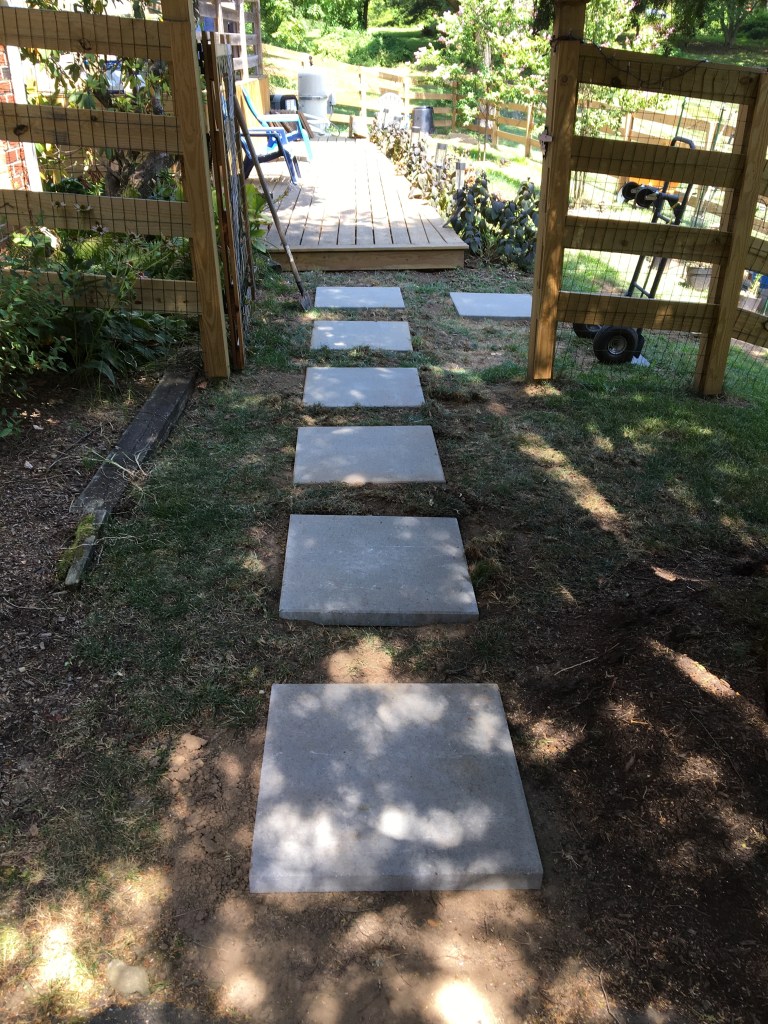
If you are trying to create a simple pedestrian pathway, removing a couple layers of your lawn where you will be walking and replacing with wood chips or mulch suffices. If you like hardscaping, pavers and stones can be installed directly into the lawn (as pictured above). If you are looking for a more continuous path and don’t want concrete, then properly installing a masonry paver path with weed barrier covered by a couple inches of crushed rock/sand and then pavers will allow adequate moisture distribution while preventing moisture build up around the weed fabric. Where permeability is not as much of a concern, such as with a walking path or smaller area, opting for a woven weed barrier, as pictured below, will provide even greater longevity than using non-woven material (there’s sand below this fabric. Trust me!).

How not to get lost in the weeds
With the exception of using an intense, less permeable method such as putting woven geotextile landscape barrier under crushed stone beneath a shrub in the shade, there is a fairly highly likelihood that at some point, your weed barrier efforts will probably lead to some (or much) weed emergence. However, if you avoid some of the problems listed above, you can save your time, money and energy by using weed barrier where and how it is most effective in order to keep the weeds under wraps.
If you have any questions or wish for some assistance in waging war against the weeds, feel free to reach out and we can help your landscape stay (relatively) weed-free!
 ECOworks llc