
DISCLAIMER: This post contains links to affiliate websites. You are in no way obligated to purchase this product if you click on the link. If you do click on the link, ECOworks will receive a portion of the proceeds from your purchase. If you wish to support ECOworks, thank you for your support and consideration!
In November of 2024, I acquired a Ryobi gas powered chainsaw off of Facebook marketplace (thank you, Mark Zuckerberg, for facilitating that transaction). It would start and run but when the throttle was pressed, it would gradually sputter to a stop. I spent the winter trying to troubleshoot and replacing basic components, such as the air and fuel filter, but no dice.
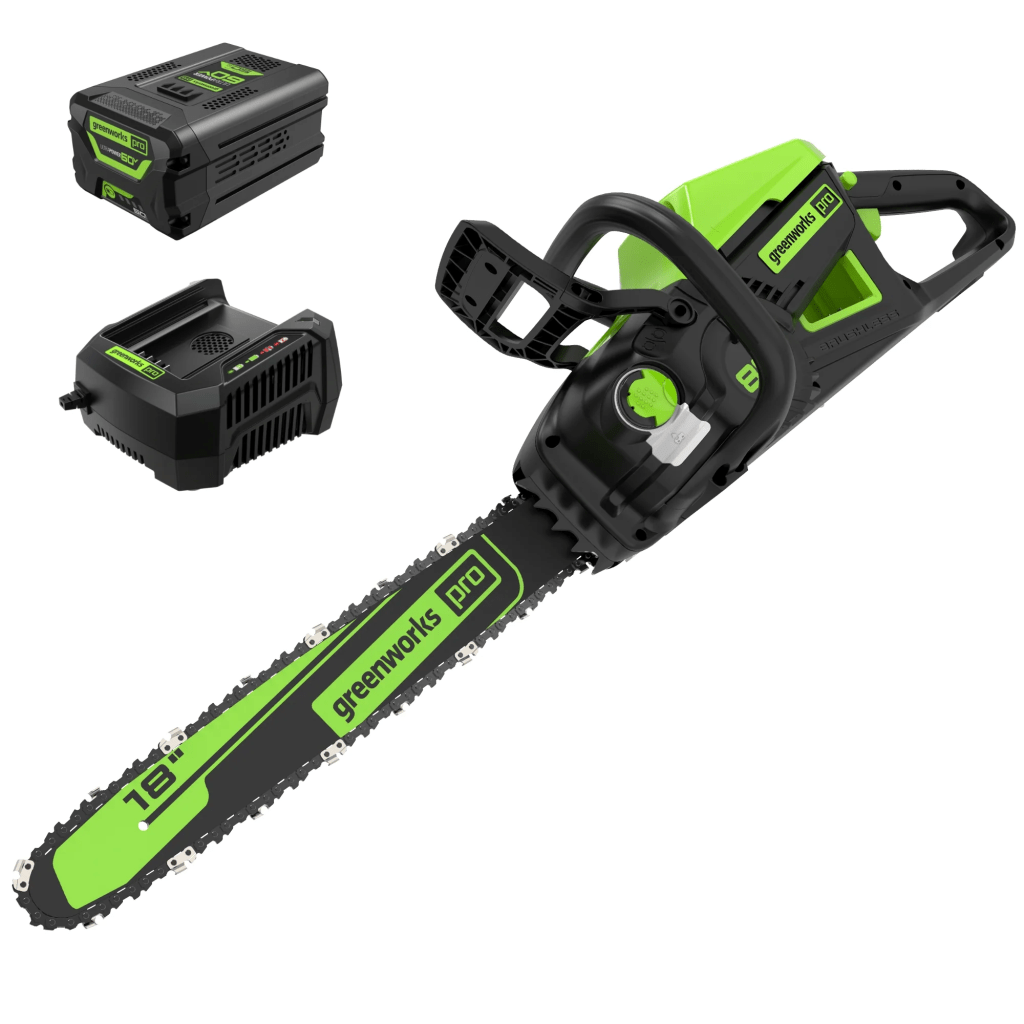
When landscaping season kicked in, I encountered various projects beyond the scope of my trusty 8″ pole saw (coming soon to this blog!). I was solicited to detach a broken branch from a storm-struck cherry tree, and then eventually asked to remove the cherry tree (sorry, George Washington). It was a scraggly, shaded specimen at about 12′ in height and 14″ in diameter that required a chainsaw. So, after a brief commercial delay, I went ahead and acquired the Greenworks 60 Volt 18″ chainsaw.
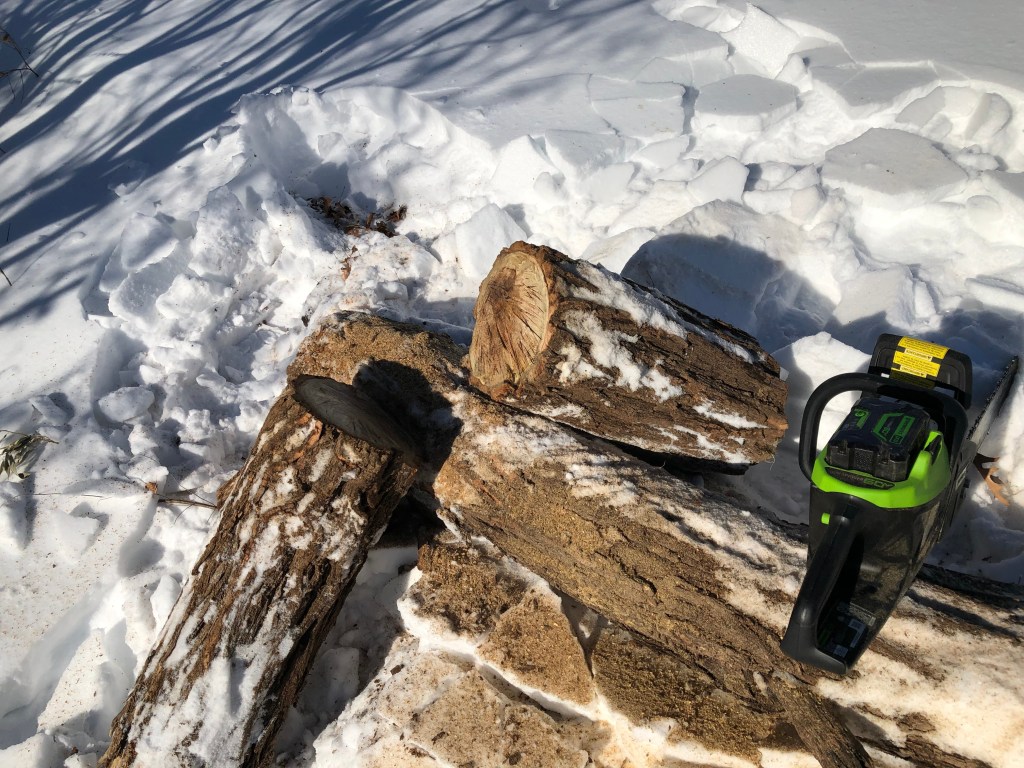
How does it perform? After a season of using it somewhat regularly, including cutting some black locust logs removed from another property (as pictured below), I would say that there are various benefits and limitations to this tool.
Benefits:
- As with any electric chainsaw, the maintenance required is negligible compared to a gas chainsaw. Aside from making sure the chain is oiled and sharpened occasionally, you pretty much need to keep a battery charged and you’re good to go. No winterizing, carburetor, filters, spark plug, gas, or exhaust issues. Just a green, cutting machine!
- Since I had already invested in the Greenworks 60 Volt hedge trimmer and am pleased with that tool, I bought this in part to have a back-up battery for that as larger projects can deplete the battery. I guess it’s a tomato/potato debate, as once you invest in a battery system, most people stick with a brand and voltage to minimize batteries and chargers. I would say that the continuous battery run time under load is about 20-30 minutes or so, which is reasonable for an electric chainsaw; it says 180 cuts, but that is pretty vague given real world variability in wood diameter and density.
- I find that the 18″ bar provides ample length for most cutting that one will do in a suburban setting outside of a commercial tree operation. It also comes with a bar cover to keep it protected (not pictured), which is welcome, and the chain is still fairly sharp after a year of use.
- The chainsaw with the charger weighs 13.4 pounds, which is reasonable compared to other models I researched. Not as light as a plug in, but lighter than other battery models and gas models.
- The chainsaw is listed as $399 with a battery and charger. The battery has a 4 year warranty. Compared to other chainsaws I researched, the cost is middle of the road, with the battery lifespan at the longer end given the voltage. So, a modest investment, but worthwhile if you regularly use a lighter chainsaw and/or want to buy a duplicate battery for other Greenworks equipment (with the equipment to boot).
Limitations
- The battery is listed as having a 50 minute recharge time. I would say it’s more like 75-90 minutes. Not that big of a deal all things considered, but once you run out of charge, you will definitely have to wait a little to get going again. Then again, perfect for a midday lunch break!
- The battery that comes with the chainsaw is 5.0 Amp hours. When using the 60 Volt/ 2.5 Amp hour battery from the hedge trimmer, I find that, aside from the reduced battery run time, there is a slight dip in power. So, if you are trying to extend battery run time with duplicate batteries, you may want to invest in more batteries of similar amp hour. On the flip side, the hedge trimmer runs perfectly on the 5.0 Amp hour battery!
- Regarding power output and cutting ability, the chainsaw is listed as equivalent to a 50 cc gas chainsaw and operating at 82 feet/second. I found felling the cherry tree to be relatively straightforward, although the battery eventually petered out and required the back-up. When cutting the black locust logs, which ranged from 10-16″, the chainsaw struggled a bit and needed some log adjustment to finally cut through various logs. I haven’t had a chance to test on other hardwoods such as oak or hickory, but have found that cutting through black walnut and pine to be straightforward. Now that I got my Ryobi finally running, there is a modest difference in power output in comparison.
- The chain is somewhat finicky. Despite constantly checking the tension and adjusting the tension adjusting screw, I have found that the chain can loosen enough that it will pop off. Relative to the slight decrease in power output, proper log position becomes even more crucial, such as with undercuts for a limb with one side contacting the ground to avoid having a stuck bar and chain. Just be mindful that you will need to make sure the chain is appropriately tight every time you use it. Like every chainsaw, you should periodically check the chain and adjust accordingly after use.
- As with every chainsaw, oil is required to lubricate the chain. I find that the oil economy is reasonable, however, there may be residual oil from the chain after use on the bar or seeping onto the bar. Store it in a place where you don’t mind a little oil!
The verdict? If you are a homeowner who needs to limb the occasional branch, take down the occasional, smaller tree or who needs to cut up various pieces of firewood 16″ or smaller, this chainsaw is a worthwhile and value-oriented piece of equipment for your arsenal. If you have aspirations of being a lumberjack, I would recommend investing in a more appropriate, likely gas-powered, piece of equipment (and a big, blue ox).
If you are looking for some lighter tree work or property clean-up in the Philadelphia metropolitan area and don’t want to invest in a chainsaw yourself, please contact ECOworks so we can keep your property trimmed and prim.
 ECOworks llc